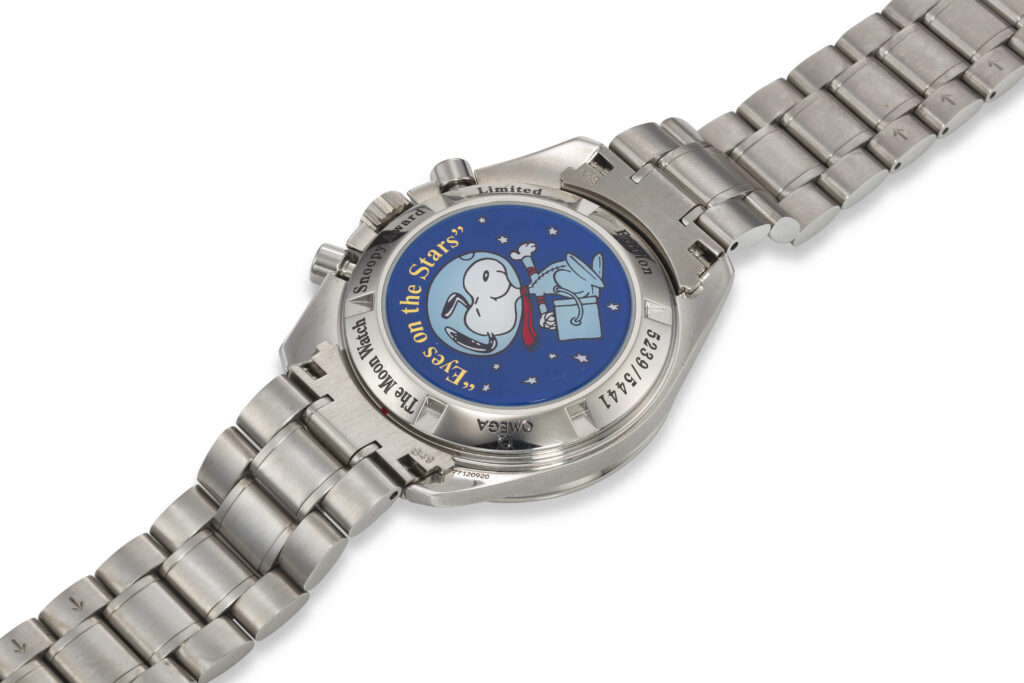
Snoopy’s unlikely journey onto the Omega Speedmaster traces back to one of the most dramatic moments in the history of spaceflight. The connection begins with Apollo 10, the dress rehearsal for Apollo 11. During that mission, NASA astronauts used official call signs drawn from the popular Peanuts universe: the Command Module was named “Charlie Brown,” while the Lunar Excursion Module was dubbed “Snoopy,” a nod to its task of “snooping around” the Moon to scout landing sites. At the time, Snoopy was already a cultural icon, thanks in part to his alter ego as the World War I Flying Ace and the success of animated specials like A Charlie Brown Christmas.
That popularity soon intersected with the space program in a more formal way. In 1968, NASA created the Silver Snoopy Award to recognize exceptional contributions by engineers, technicians, contractors, and support staff whose work directly enhanced mission safety and success. The award, conceived by NASA public affairs director Al Chop, was unique in that it was presented personally by astronauts. Recipients received a small silver Snoopy pin, often one that had actually flown in space, reinforcing the bond between astronauts and the vast teams supporting them on the ground.
The Silver Snoopy Award became forever linked with Apollo 13, often described as NASA’s most successful failure. On April 13, 1970, an oxygen tank exploded in the Service Module during a routine procedure, crippling the spacecraft and forcing the crew and mission control into a desperate fight for survival. Among the many improvised solutions was using the Lunar Module as a lifeboat and executing a precisely timed mid-course correction burn. Lacking reliable onboard systems, the astronauts relied on their Omega Speedmaster chronographs to time a critical 14-second engine firing. The maneuver worked flawlessly, and Apollo 13 splashed down just miles from its intended recovery point.
In recognition of that contribution, the Apollo 13 crew presented Omega with the Silver Snoopy Award in 1970. More than three decades later, the brand chose to commemorate the moment with a special Speedmaster. In 2003, Omega released the Speedmaster Professional Snoopy Award Limited Edition, reference 3578.51.00. Produced in a run of 5,441 pieces—a number referencing the mission’s total duration of 142 hours, 54 minutes, and 41 seconds—the watch featured a playful Snoopy illustration on the running seconds subdial at 9 o’clock and an engraved Snoopy medallion on the caseback. Inside was the manual-wind Caliber 1861, the same movement architecture used in Moonwatches worn by astronauts.
Though the edition was relatively large by limited-edition standards, demand has steadily climbed, and the watch now trades well above its original retail price. Its appeal lies not just in scarcity, but in the story it tells: a reminder that, in one of spaceflight’s darkest hours, a simple mechanical chronograph played a role in bringing three astronauts safely home. That legacy is why Snoopy, once a cartoon beagle, earned a permanent place in horological and spaceflight history.