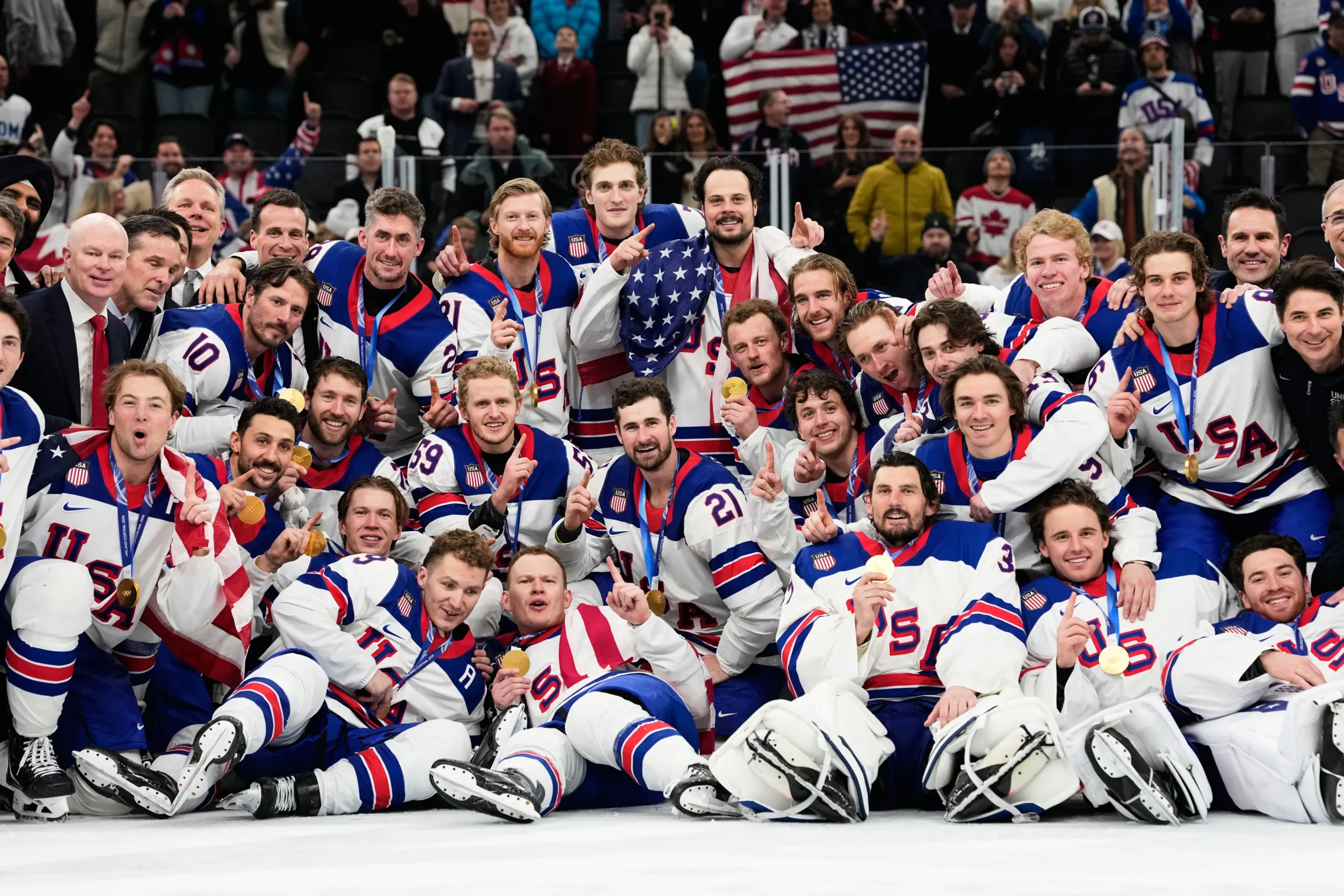
For the first time since the 1980 “Miracle on Ice” at the Winter Olympics, the United States has reclaimed Olympic gold in men’s hockey, defeating Canada 2–1 in a dramatic 3-on-3 overtime finish at the 2026 Winter Games. Forty-six years after its last Olympic triumph, Team USA climbed back to the top of the sport, ending Canada’s reign in best-on-best international competition and delivering one of the most significant victories in modern American hockey history.
The winning moment came 1:41 into overtime, when Jack Hughes buried the golden goal past Canadian goaltender Jordan Binnington. Bloodied and missing teeth after absorbing a high stick in the third period, Hughes showed remarkable toughness, finishing a cross-ice feed from Zach Werenski, who had stripped the puck away from Nathan MacKinnon to create the opportunity. The goal secured the United States’ third Olympic gold medal in men’s hockey and immediately etched Hughes’ name alongside the legends of American hockey lore.
The Americans had seized momentum early thanks to a brilliant individual effort from Matt Boldy. Six minutes into the first period, Boldy slipped the puck over the sticks of defensemen Cale Makar and Devon Toews, splitting them cleanly before scoring on the backhand. The goal gave the U.S. a 1–0 lead and stunned the Canadian team. However, Canada responded with a dominant second period, outshooting the Americans 19–8 and applying relentless pressure. Midway through the frame, Team USA survived a crucial 93-second 5-on-3 penalty kill — a unit that went a perfect 18-for-18 on the penalty kill throughout the tournament.
Canada eventually broke through late in the second period when Makar beat U.S. netminder Connor Hellebuyck with a perfectly placed wrist shot from the right faceoff circle, tying the game at 1–1. From there, the contest evolved into a goaltending showcase. Canada finished with a commanding 42–28 edge in shots, but Hellebuyck delivered a 41-save masterpiece, repeatedly denying point-blank chances and weathering sustained third-period pressure. Time and again, he turned aside Canada’s high-powered attack, forcing overtime and giving his teammates the chance to win it.
The win also carried historical weight. Canada entered the game riding a 15-game Olympic winning streak in best-on-best play dating back to a 2010 round-robin loss to the United States. During that span, Canada captured gold at Vancouver 2010 and Sochi 2014, along with titles at the 2016 World Cup of Hockey and last year’s 4 Nations tournament. Since NHL players began participating in the Olympics in 1998, Canada had consistently owned the rivalry in gold-medal settings, defeating the Americans in 2002 and 2010 and blanking them in the 2014 semifinal. This time, however, the narrative shifted.
Canada also played without longtime captain Sidney Crosby, who was ruled out of the final with a lower-body injury despite attempting to return after skating in a closed practice. Ultimately, though, the night belonged to the United States. In a fast-paced, fiercely contested showdown between the sport’s two superpowers, it was Hughes’ golden goal and Hellebuyck’s brilliance that defined a new chapter in the rivalry — one that ended with American players draped in gold and a 46-year wait finally over. This time, the Americans seized their moment, reclaiming the top of the Olympic podium and delivering one of the most memorable wins in U.S. hockey history.
JACK HUGHES DELIVERS AMERICA'S GOLDEN MOMENT IN OVERTIME. pic.twitter.com/4foFDOri53
— NBC Olympics & Paralympics (@NBCOlympics) February 22, 2026
THAT WAS ONE HELLE-BUYCK OF A STOP. 😳 pic.twitter.com/N3wCimdBGw
— NBC Olympics & Paralympics (@NBCOlympics) February 22, 2026